Nondestructive Testing (NDT)
Liquid Penetrant Testing (PT)
Liquid Penetrant Testing (PT) applies a specialized dye — visible or fluorescent — to a component's surface. The dye is drawn into microscopic surface-breaking cracks and made clearly visible under the right lighting conditions.
PT is highly sensitive to fine surface defects and works on both metallic and non-metallic non-porous materials, making it a go-to method for aluminum aircraft structures and non-ferrous components where MT isn't applicable.
It's frequently specified for weld inspection, machined parts, and castings during both manufacturing and in-service maintenance.
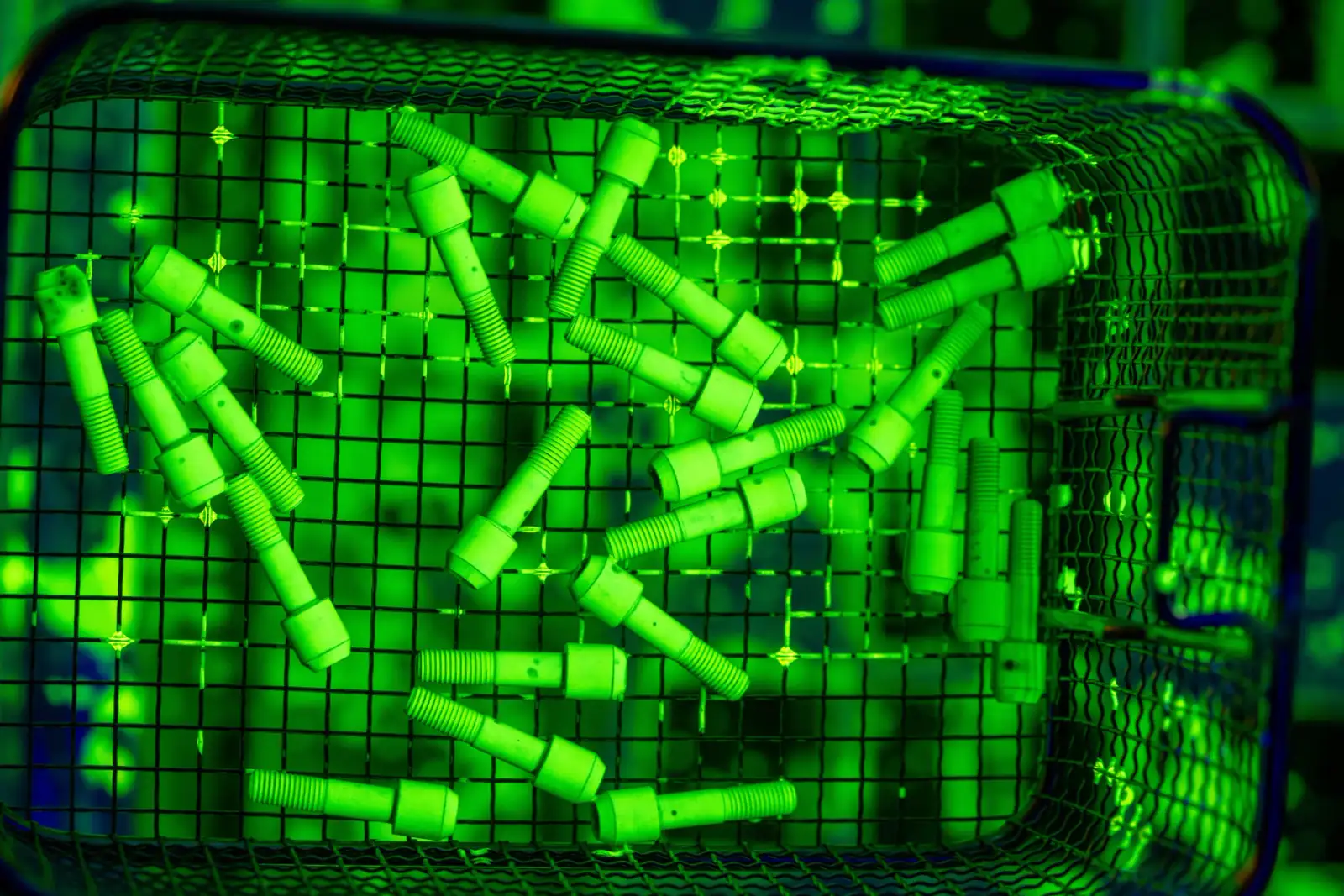
What's Included
- Visible-dye and fluorescent penetrant methods
- Surface-crack detection on aluminum, titanium, and non-ferrous alloys
- Weld and casting inspection
- Compliant with applicable ASTM and aerospace specifications
Who It's For
Manufacturers and repair stations working with non-ferrous or non-magnetic materials — aluminum structures, castings, and precision-machined parts.
What PT Finds — and Its Limits
PT finds defects that break the surface — cracks, porosity, laps, and seams — on non-porous metals and non-metals, including aluminum, titanium, and austenitic stainless steel that MT can't inspect.
It only finds flaws open to the surface, and it doesn't suit porous or very rough materials. Parts need to be clean before testing; we confirm any surface preparation with you in advance.
Procedures and Standards
Every inspection follows a written procedure and the acceptance criteria in your governing document. That may be AWS D1.1 for welds, an ASTM standard, an aerospace specification, or your customer's own specification.
Tell us which specification governs your part, and we'll confirm the penetrant type and acceptance criteria before work starts.
Related Reading
Liquid Penetrant Testing FAQ
What can liquid penetrant testing detect?
Cracks, porosity, laps, seams, and other defects open to the surface of non-porous materials. It cannot find flaws that lie entirely below the surface.
Does PT work on aluminum and stainless steel?
Yes. PT works on most non-porous metals and non-metals, which makes it the usual surface method for aluminum, titanium, and austenitic stainless steel, where MT doesn't apply.
Do you perform PT on-site?
Yes. We inspect at your facility or job site — in Miami, across South Florida, and anywhere else by request.
Ready to talk about your project?
Call (657) 430-4666, email info@lionndt.com, or send a message and we'll follow up promptly.
Related Services
Ultrasonic Testing (UT)
Volumetric inspection for internal flaws and precise thickness measurement.
Magnetic Particle Testing (MT)
Fast surface and near-surface crack detection on ferromagnetic parts.
Visual Testing (VT)
The foundation of NDT — direct and remote-visual inspection for damage and corrosion.
Eddy Current Testing (ET)
Fast, portable electromagnetic inspection for cracks and corrosion in conductive materials.